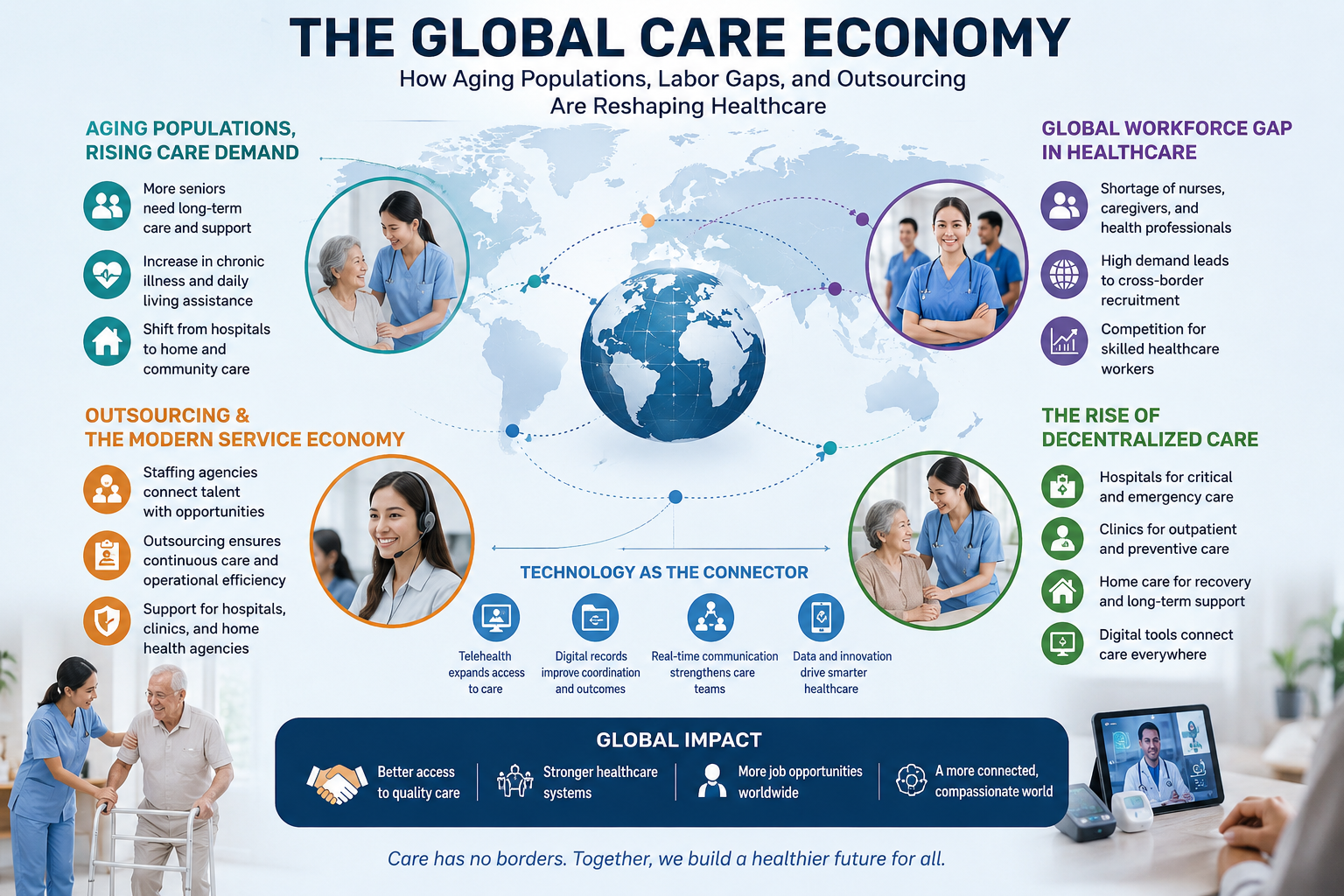
Across the world, healthcare is no longer just a medical system—it is becoming part of a much larger global care economy shaped by demographics, workforce movement, and economic pressure.
Countries are facing a shared challenge: more people need care, but fewer workers are available to provide it locally.
👵 Aging Populations and Rising Care Demand
One of the biggest drivers of change is the rapid aging of populations in developed countries. As life expectancy increases, so does the number of individuals needing long-term support, including:
- Home-based assistance
- Chronic disease management
- Rehabilitation and therapy services
- Daily living support for seniors
This shift is putting pressure on traditional hospital-based systems, pushing care toward more flexible and community-based solutions.
🌍 The Global Workforce Gap in Healthcare
At the same time, healthcare systems are experiencing critical staffing shortages. Nurses, caregivers, and support staff are in high demand, but supply is not keeping up.
This has led to:
- Increased recruitment across borders
- Growth of healthcare staffing agencies
- Dependence on outsourced workforce solutions
- Higher competition for skilled medical professionals
Healthcare is now deeply connected to global labor mobility—where workers often move between countries to fill urgent care needs.
🏢 Outsourcing and the Modern Service Economy
To manage these shortages, many healthcare systems and providers rely on outsourcing and staffing networks.
These systems help:
- Match qualified professionals with healthcare facilities
- Provide temporary or permanent staffing support
- Ensure continuity of care in hospitals and home health services
- Reduce operational strain on local healthcare systems
What was once a local service is now part of a global supply chain of care workers and support systems.
🏠 The Rise of Decentralized Care
Because of these pressures, care delivery is shifting away from centralized hospitals toward a more distributed model:
- Hospitals handle critical and emergency cases
- Clinics manage outpatient and preventive care
- Home-based care supports recovery and long-term needs
- Remote monitoring and digital health tools connect everything together
This creates a system where healthcare is no longer tied to one place—but flows across homes, institutions, and even countries.
💡 Technology as the Connector
Digital tools are making this global system possible. Telehealth, electronic records, and remote monitoring allow healthcare providers to support patients without physical presence.
Technology also helps staffing systems:
- Match workers to jobs faster
- Track credentials and compliance
- Improve coordination across agencies
- Support real-time communication between care teams
🌱 Final Insight
Healthcare today is no longer just about hospitals or individual agencies.
It is part of a global care network, shaped by aging populations, workforce migration, outsourcing systems, and digital transformation.
At the center of it all is a simple reality:
Care is becoming borderless—delivered by people, supported by systems, and sustained by global cooperation.